

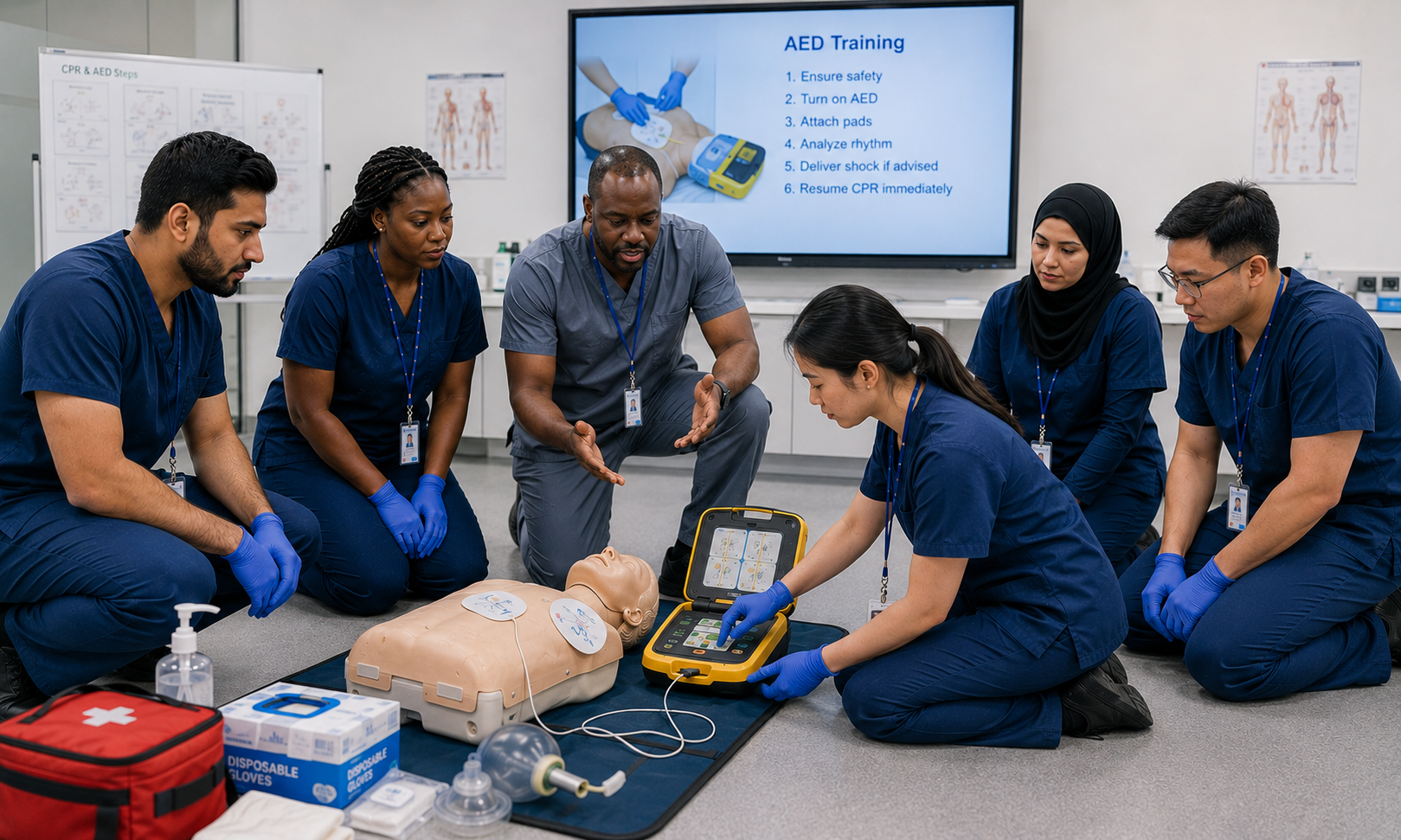
AED Training – Automated External Defibrillator Training
Develop the essential knowledge and practical skills required to recognise sudden cardiac arrest and use an Automated External Defibrillator (AED) safely and effectively.
Our AED Training introduces learners to early recognition of cardiac arrest, activation of the emergency response system, high-quality CPR, AED preparation, correct electrode-pad placement, safe shock delivery and effective integration of AED use with cardiopulmonary resuscitation (CPR).
Through instructor-led demonstrations and supervised hands-on practice using AED trainers and CPR manikins, participants develop the confidence and practical skills needed to respond appropriately during simulated cardiac emergencies.
AED Training – Course Overview
Automated External Defibrillator (AED) Training provides learners with the essential knowledge and practical skills required to recognise sudden cardiac arrest and use an AED safely and effectively.
The programme introduces the principles of early recognition and emergency response, including assessment of an unresponsive casualty, activation of emergency medical assistance, high-quality cardiopulmonary resuscitation (CPR) and timely use of an AED.
Learners are introduced to the components and basic operation of an AED, correct electrode-pad placement, analysis of heart rhythm by the device, shock-safety precautions and appropriate actions when a shock is advised or not advised.
Through instructor-led demonstrations, guided hands-on practice and simulated cardiac-arrest scenarios, participants develop the ability to integrate AED use with CPR while minimising interruptions to chest compressions.
The training emphasises personal and scene safety, clear communication, following AED prompts correctly, rapid resumption of CPR after rhythm analysis or shock delivery, and confident action within the responder's level of training.
Learning Objectives
The AED – Automated External Defibrillator Training programme is designed to enable learners to:
✓ Understand the purpose and principles of Automated External Defibrillator (AED) use
✓ Recognise the signs of sudden cardiac arrest
✓ Assess responsiveness and breathing in an unresponsive casualty
✓ Activate the emergency response system and obtain an AED promptly
✓ Understand the importance of early CPR and early defibrillation
✓ Perform high-quality CPR while preparing an AED for use
✓ Identify the main components and basic functions of an AED
✓ Prepare a casualty appropriately for AED pad placement
✓ Demonstrate correct AED electrode-pad placement
✓ Follow AED visual and voice prompts correctly
✓ Maintain safety during rhythm analysis and shock delivery
✓ Respond appropriately when a shock is advised or not advised
✓ Minimise interruptions to chest compressions during AED use
✓ Resume CPR promptly following rhythm analysis or shock delivery
✓ Demonstrate effective communication during a cardiac-arrest response
✓ Apply appropriate AED considerations for children when applicable
✓ Integrate CPR and AED use effectively during simulated cardiac-arrest scenarios
✓ Apply AED principles confidently within the responder's level of training
Course Content
The AED – Automated External Defibrillator Training programme covers the essential knowledge and practical skills required to recognise sudden cardiac arrest, perform effective CPR and use an AED safely and appropriately. Core areas include:
1. Introduction to Automated External Defibrillation (AED)
Purpose of an AED, role of early defibrillation, responder responsibilities and the importance of rapid intervention during sudden cardiac arrest.
2. Sudden Cardiac Arrest Recognition
Recognising an unresponsive casualty, assessing breathing, identifying suspected cardiac arrest and understanding the need for immediate emergency action.
3. Chain of Survival & Emergency Response
Early recognition, activation of emergency medical services, early CPR, rapid defibrillation and appropriate continuation of care until professional help arrives.
4. High-Quality CPR
Correct positioning, effective chest compressions, appropriate ventilation, minimising interruptions and maintaining CPR while an AED is being prepared.
5. AED Components & Basic Operation
Introduction to common AED components, controls, electrode pads, cables, visual indicators and voice or visual prompts.
6. Preparing the Casualty for AED Use
Safe positioning, exposing and preparing the chest, identifying factors that may affect pad placement and preparing for effective electrode contact.
7. AED Electrode-Pad Placement
Correct adult pad positioning, following manufacturer diagrams and understanding appropriate placement considerations for different casualties.
8. Rhythm Analysis & Shock Safety
Allowing the AED to analyse the rhythm, ensuring nobody is touching the casualty and maintaining a safe environment during analysis and shock delivery.
9. Shock Advised & No-Shock-Advised Actions
Following AED prompts appropriately, delivering a shock when instructed and understanding the immediate actions required when no shock is advised.
10. Integrating AED Use with CPR
Coordinating CPR and AED operation, minimising pauses in chest compressions and resuming CPR immediately after analysis or shock delivery.
11. AED Use in Children
Basic considerations for paediatric AED use, appropriate pads or paediatric settings when available, and following applicable device instructions and training protocols.
12. Special Situations & Safety Considerations
Awareness of wet environments, medication patches, implanted medical devices, excessive chest hair and other circumstances that may require appropriate precautions.
13. Practical AED Scenarios & Skills Assessment
Hands-on AED operation, pad-placement practice, CPR–AED integration, simulated sudden-cardiac-arrest scenarios and competency-based assessment of essential AED skills.
Practical AED Training & Activities
The programme combines essential AED knowledge with supervised hands-on practice and simulated cardiac-arrest scenarios designed to develop confidence, competence and safe AED operation. Participants may undertake activities such as:
✓ Performing an initial assessment of an unresponsive casualty
✓ Recognising suspected sudden cardiac arrest
✓ Activating the emergency response system and obtaining an AED
✓ Practising high-quality CPR before and during AED use
✓ Identifying the main components and controls of an AED trainer
✓ Switching on and preparing an AED trainer for use
✓ Preparing the casualty's chest for electrode-pad placement
✓ Demonstrating correct adult AED pad placement
✓ Practising appropriate paediatric AED considerations
✓ Following AED voice and visual prompts correctly
✓ Maintaining a clear casualty during rhythm analysis
✓ Demonstrating safe “stand clear” procedures before shock delivery
✓ Responding correctly when a shock is advised
✓ Responding correctly when no shock is advised
✓ Resuming CPR immediately following rhythm analysis or shock delivery
✓ Minimising interruptions to chest compressions during AED operation
✓ Practising AED use in selected special situations
✓ Communicating effectively with other responders during resuscitation
✓ Participating in simulated sudden-cardiac-arrest scenarios
✓ Completing integrated CPR and AED scenarios from initial assessment through continued emergency response

Assessment & Training Approach
The AED – Automated External Defibrillator Training programme uses a practical, learner-centred and scenario-based approach to develop the knowledge, confidence and hands-on skills required for safe and effective AED use during suspected sudden cardiac arrest.
Learning Approach:
Training combines instructor-led teaching, demonstrations, guided hands-on practice, CPR–AED integration exercises, scenario-based learning and supervised simulated cardiac-arrest responses.
Practical Application:
Learners apply AED principles through practical activities involving casualty assessment, high-quality CPR, AED preparation, electrode-pad placement, rhythm-analysis safety, shock delivery procedures and coordinated emergency response.
Assessment:
Learner progress may be evaluated through knowledge checks, instructor observation, practical demonstrations, simulated cardiac-arrest scenarios and competency-based assessment of essential AED skills.
Learning Resources:
Participants may work with adult and paediatric CPR manikins, AED trainers, training electrode pads, resuscitation masks, barrier devices and other appropriate emergency-response training resources.
Training Delivery:
The programme combines structured theoretical instruction with supervised practical and scenario-based training. Delivery arrangements are subject to the programme schedule and available training options.
Who Should Enrol?
The AED – Automated External Defibrillator Training programme is suitable for individuals who want to develop the knowledge and practical skills required to respond effectively to suspected sudden cardiac arrest and use an AED safely. It may be particularly relevant for:
✓ Healthcare professionals and clinical support staff
✓ Nurses, nursing assistants and healthcare assistants
✓ Caregivers and home-care professionals
✓ First responders and emergency-support personnel
✓ Workplace health and safety personnel
✓ Security personnel and workplace emergency-response teams
✓ Teachers, school staff and childcare professionals
✓ Fitness, sports and recreation professionals
✓ Hospitality and customer-service personnel
✓ Community and public-safety personnel
✓ Individuals responsible for workplace AED response
✓ Employees working in locations where AEDs are available
✓ Individuals seeking practical CPR and AED training
✓ Parents, guardians and individuals responsible for the care of others
✓ Members of the public interested in developing emergency-response and life-saving skills
Course Information
Training Programme: AED – Automated External Defibrillator Training
Training Focus: Sudden Cardiac Arrest Recognition, CPR, AED Use & Emergency Response
Learning Approach: Instructor-led teaching, demonstrations, guided hands-on practice and scenario-based learning
Practical Components: Casualty assessment, high-quality CPR, AED preparation, electrode-pad placement, rhythm-analysis safety, shock delivery procedures and CPR–AED integration
Assessment: Knowledge checks, instructor observation, practical demonstrations, simulated cardiac-arrest scenarios and competency-based assessment of essential AED skills
Delivery: Classroom-based instruction with supervised practical and scenario-based training, subject to programme schedule and available delivery arrangements
Certificate: Certificate of Completion upon successful completion of the training
Location: Global Healthcare Hub, UAE
Ready to Build Your AED Emergency-Response Skills?
Take the next step towards developing practical skills in CPR, AED use and sudden cardiac-arrest response. Contact Global Healthcare Hub today for information about upcoming AED Training dates, enrolment requirements, delivery arrangements and course availability.