


Central Sterile Services Department (CSSD)
Develop the knowledge and practical skills required for safe cleaning, decontamination, inspection, packaging, sterilization, storage and distribution of reusable medical instruments. Our CSSD Training introduces learners to the essential principles of sterile processing, infection prevention and quality assurance within healthcare facilities.
Through structured learning and practical activities, participants develop the competencies needed to support safe instrument reprocessing, maintain sterilization standards and contribute to effective infection prevention and patient safety.
CSSD Training – Course Overview
CSSD Training provides learners with a structured introduction to the principles, procedures and safety requirements involved in the reprocessing of reusable medical devices and surgical instruments within healthcare facilities.
The programme covers the complete sterile-processing cycle, including receiving contaminated items, cleaning and decontamination, inspection and assembly, packaging, sterilization, storage and distribution of sterile supplies.
Learners are introduced to infection prevention and control, occupational safety, correct handling of instruments, sterilization methods, monitoring of sterilization processes, documentation, traceability and quality assurance within the CSSD environment.
Through practical demonstrations, guided activities and realistic sterile-processing scenarios, participants develop the knowledge and skills required to contribute to safe, consistent and effective CSSD practice.
The training also emphasizes the importance of maintaining the correct workflow between dirty, clean and sterile areas to reduce the risk of cross-contamination and support patient safety.
Learning Objectives
The CSSD Training programme is designed to enable learners to:
✓ Understand the role and functions of the Central Sterile Services Department (CSSD) within healthcare facilities
✓ Explain the principles of infection prevention and control relevant to sterile processing
✓ Understand the correct workflow between contaminated, clean and sterile areas
✓ Identify common reusable medical devices and surgical instruments
✓ Apply safe procedures for receiving, handling and transporting contaminated instruments
✓ Understand appropriate cleaning and decontamination methods for reusable medical devices
✓ Inspect instruments for cleanliness, function, damage and completeness
✓ Apply appropriate assembly, packaging and labelling principles before sterilization
✓ Understand common sterilization methods and their appropriate applications
✓ Explain the use of physical, chemical and biological monitoring in sterilization processes
✓ Apply appropriate principles for storage, handling and distribution of sterile supplies
✓ Understand documentation, traceability and quality-assurance requirements in CSSD practice
✓ Recognise occupational hazards and apply appropriate PPE and safety measures
✓ Identify sterilization failures and understand appropriate corrective actions
✓ Apply CSSD principles to support infection prevention, patient safety and quality healthcare delivery
Course Content
The CSSD Training programme covers the essential stages of medical-device reprocessing, sterilization, infection prevention and quality assurance. Core areas include:
1. Introduction to CSSD & Sterile Processing
Role and functions of CSSD, departmental responsibilities, sterile-processing principles and the importance of CSSD in infection prevention and patient safety.
2. Infection Prevention & Control in CSSD
Standard precautions, hand hygiene, transmission of infection, cross-contamination prevention, environmental hygiene and appropriate use of personal protective equipment (PPE).
3. CSSD Design, Zoning & Workflow
Principles of one-way workflow, contaminated/dirty areas, clean areas, sterile areas, environmental controls and prevention of cross-contamination.
4. Medical & Surgical Instrument Identification
Identification, classification, function, handling and basic care of common surgical instruments and reusable medical devices.
5. Receiving, Sorting & Decontamination
Safe transportation and receipt of contaminated items, sorting, pre-cleaning, manual cleaning, mechanical cleaning, ultrasonic cleaning and washer-disinfection processes.
6. Inspection, Testing & Instrument Assembly
Inspection for cleanliness and damage, functional testing, instrument lubrication, assembling instrument sets and preparing items for packaging.
7. Packaging & Preparation for Sterilization
Selection of packaging materials, wrapping techniques, sterilization pouches, containers, labelling, chemical indicators and preparation of sterilization loads.
8. Sterilization Methods & Processes
Principles of steam sterilization and an introduction to appropriate low-temperature sterilization methods, sterilization parameters, loading and safe operation principles.
9. Sterilization Monitoring & Quality Control
Physical monitoring, chemical indicators, biological indicators, sterilization records, load release principles and interpretation of monitoring results.
10. Sterile Storage, Handling & Distribution
Appropriate storage conditions, maintaining package integrity, stock rotation, transportation and safe distribution of sterile supplies.
11. Documentation, Traceability & Quality Assurance
Record keeping, instrument and load traceability, quality-control processes, audits, policies, procedures and continuous quality improvement.
12. Occupational Safety, Incident Management & Sterilization Failure
Sharps safety, chemical and thermal hazards, exposure prevention, incident reporting, failed sterilization cycles, recall procedures and appropriate corrective actions.
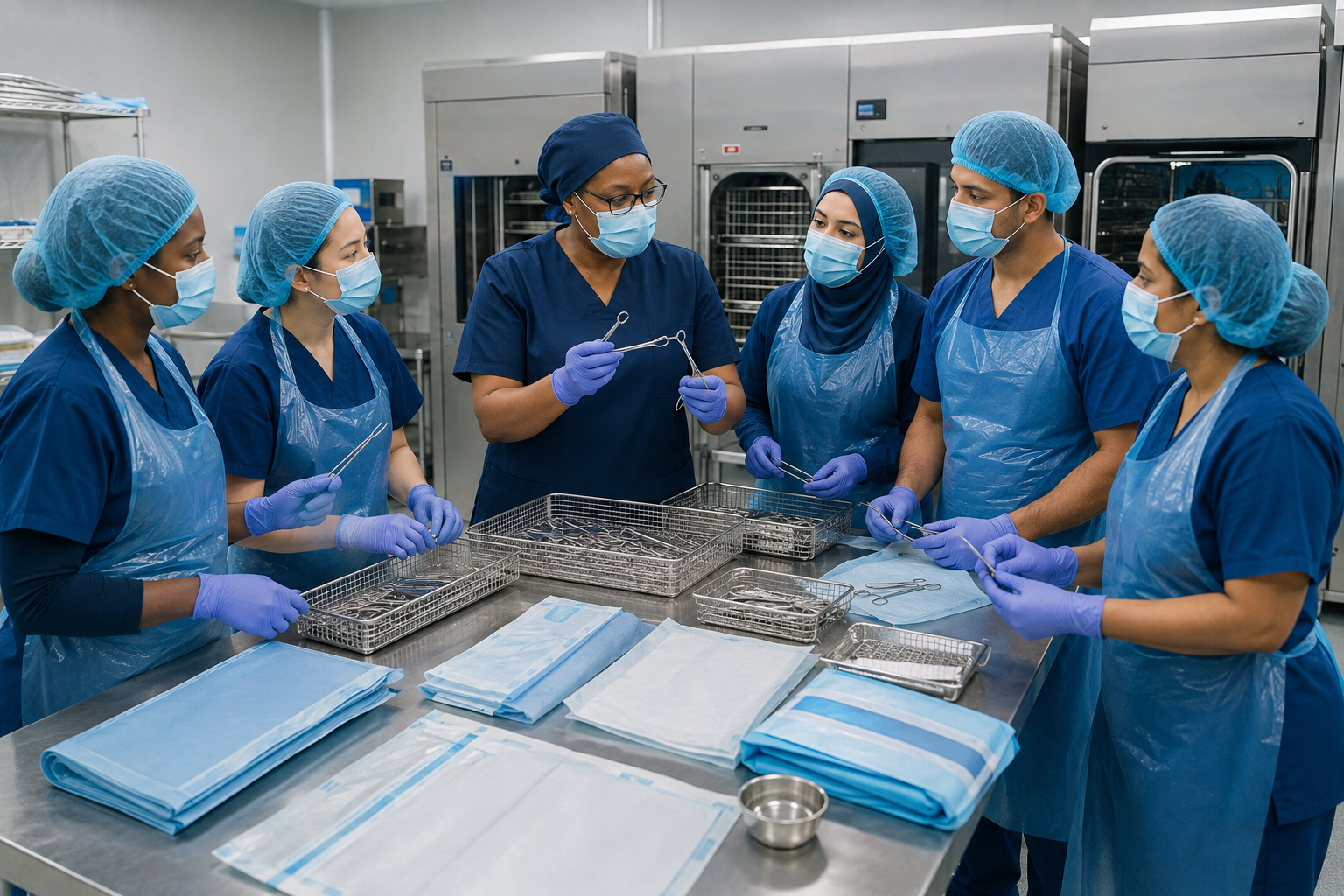
Practical CSSD Training & Activities
The programme combines essential theoretical knowledge with practical sterile-processing activities designed to help learners apply CSSD principles safely and effectively within realistic healthcare environments. Participants may undertake activities such as:
✓ Identifying and correctly handling common reusable surgical instruments
✓ Demonstrating appropriate PPE use and safe handling of contaminated items
✓ Practising the correct movement of instruments through dirty, clean and sterile areas
✓ Performing manual cleaning and decontamination procedures
✓ Preparing instruments for mechanical and ultrasonic cleaning
✓ Inspecting instruments for cleanliness, damage and functionality
✓ Assembling and organising surgical instrument sets
✓ Practising appropriate packaging, wrapping and labelling techniques
✓ Preparing and loading items correctly for steam sterilization
✓ Reviewing physical, chemical and biological sterilization indicators
✓ Interpreting sample sterilization monitoring records
✓ Practising sterile storage, handling and stock-rotation procedures
✓ Completing CSSD documentation and traceability exercises
✓ Responding to simulated sterilization failures and recall scenarios
✓ Applying quality-assurance and infection-prevention principles throughout the CSSD workflow
Assessment & Training Approach
The CSSD Training programme uses a practical and learner-centred approach to develop the knowledge, technical skills and safety awareness required for effective sterile-processing practice.
Learning Approach:
Training combines instructor-led teaching, demonstrations, guided practical activities, case-based learning, group discussions and supervised sterile-processing exercises.
Practical Application:
Learners apply CSSD principles through activities involving instrument identification, decontamination, inspection, assembly, packaging, sterilization monitoring, sterile storage, documentation and quality assurance.
Assessment:
Learner progress may be evaluated through knowledge checks, practical demonstrations, instrument-processing exercises, case-based activities, written tasks and/or competency-based practical assessments.
Learning Resources:
Participants may work with reusable surgical instruments, instrument trays, PPE, packaging materials, sterilization indicators, sample documentation, traceability records, policies, procedures and other appropriate CSSD learning resources.
Training Delivery:
The programme may be delivered through classroom-based instruction and supervised practical training and/or supported online learning where appropriate, according to the programme schedule and available delivery arrangements.
Who Should Enrol?
The CSSD Training programme is suitable for individuals who want to develop or strengthen their knowledge and practical skills in sterile processing, medical-device reprocessing and infection prevention. It may be particularly relevant for:
✓ Individuals seeking to begin or develop a career in CSSD or sterile processing
✓ CSSD and sterile-processing personnel seeking to strengthen their practical knowledge and skills
✓ Healthcare assistants and support workers interested in sterile-processing services
✓ Theatre and operating-room support personnel involved in handling reusable surgical instruments
✓ Nurses and other healthcare professionals seeking greater knowledge of instrument reprocessing and sterilization
✓ Infection prevention and control personnel interested in CSSD practices
✓ Healthcare workers involved in cleaning, decontamination, preparation or handling of reusable medical devices
✓ Hospital and clinic personnel involved in sterile supply management
✓ Individuals responsible for quality assurance, documentation or traceability within sterile-processing services
✓ Healthcare graduates and students interested in developing CSSD-related competencies
✓ Individuals preparing for roles within hospital sterile-services departments
✓ Anyone seeking structured theoretical and practical training in CSSD and sterile processing
Course Information
Training Programme: Central Sterile Services Department (CSSD) Training
Training Focus: Sterile Processing, Medical Device Reprocessing & Infection Prevention
Learning Approach: Instructor-led teaching, demonstrations, guided practical exercises and case-based learning
Practical Components: Instrument identification, decontamination, inspection, assembly, packaging, sterilization monitoring, sterile storage, documentation and traceability
Assessment: Knowledge checks, practical demonstrations, case-based exercises, written activities and/or competency-based practical assessments
Delivery: Classroom-based instruction and supervised practical training and/or supported online learning where appropriate, subject to programme schedule
Certificate: Certificate of Completion upon successful completion of the training
Location: Global Healthcare Hub, UAE
Ready to Build Your Skills in CSSD & Sterile Processing?
Take the next step towards developing practical skills in sterile processing, medical device reprocessing, sterilization and infection prevention. Contact Global Healthcare Hub today for information about upcoming training dates, enrolment requirements, delivery options and course availability.